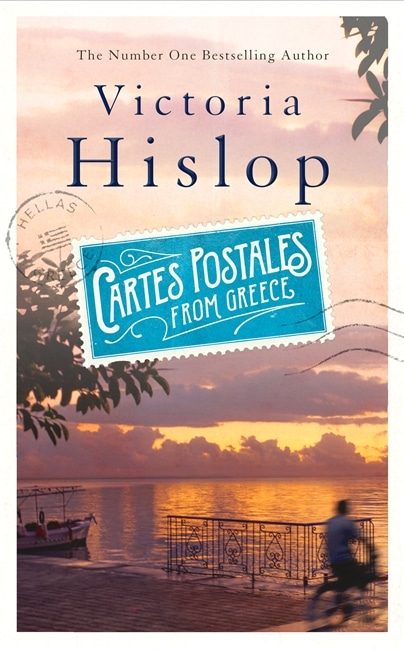
A delightful and original new book from multimillion-copy bestselling author Victoria Hislop, author of The Island and The Sunrise
Week after week, the postcards arrive, addressed to a name Ellie does not know, with no return address, each signed with an initial: A. With their bright skies, blue seas and alluring images of Greece, these cartes postales brighten her life. After six months, to her disappointment, they cease. But the montage she has created on the wall of her flat has cast a spell. She must see this country for herself.
On the morning Ellie leaves for Athens, a notebook arrives. Its pages tell the story of a man’s odyssey through Greece. Moving, surprising and sometimes dark, A’s tale unfolds with the discovery not only of a culture but also of a desire to live life to the full once more.
Cartes Postales from Greece is an extraordinary new book from Victoria Hislop, the Sunday Times Number One bestselling author of The Island, The Return, The Thread, and The Sunrise. It is fiction in full colour – magical and unique.
Cartes Postales from Greece is published on September 22.
My love for Greece began as a holiday romance nearly 40 years ago. I was a teenager and landed in Athens one blisteringly hot day in August with my mother and sister. It was only my second time out of England.
In spite of the dust, chaos, traffic and signs in a language and alphabet I didn’t understand, I was immediately enchanted. Perhaps it was the brilliance of the blue sky and the dazzling pale stones of the Acropolis, or simply the sight of swallows dipping and diving in the all-embracing warmth of our first evening there.
The charm that held me in its spell intensified when we sailed to one of the Cycladic islands. Paros, with its narrow streets of whitewashed buildings and bright splashes of bougainvillea, seemed a paradise. (Admittedly, the only real thing I had to compare it with was Bognor Regis.) We spent the day swimming in the crystal-clear sea and collecting tiny shells that were scattered across the pale sand. In the evening, we sat in waterfront tavernas, where dark-eyed waiters served generous slices of moussaka, fresh feta, sweet crimson tomatoes and huge smiles of watermelon. I had my first taste of Greek yoghurt.
It was thick and white, like cream. There was nothing like it in an English supermarket in those days.
Since then, I have travelled to Greece a hundred times or more. Turkey came later: I’ve taken a month-long overland trip in a minivan, crossing the plains of Anatolia. I’ve jumped off Mount Babadag to paraglide for an hour at 3,000ft, spying turtles in the sea below. And Istanbul is one of the most thrilling cities in the world. The restaurant bill in Turkey always comes as a pleasant surprise, too.
For me, however, if it were a choice, it would be Greece every time. I struggle to say whether I prefer the islands or the mainland. A particular city or a village? What do I love most? Is it the landscape or its ancient culture? The beaches or the mountains? The food? The climate? The people? It’s no single one of those. They are simply inseparable.
As a student, I travelled around the mainland on buses and slept rough on beaches. In between then and now, there were years of holidays in resort hotels, which were reliable and safe options for our small children. There have also been mid-range villas on the islands and mainland, and, most recently, a short stay at the Amanzoe, in the Peloponnese, which cost a staggering £750 a night.
It’s tempting to fly to Athens, then get a ferry straight out to the islands — but it would be madness not to make the hot climb up to the Parthenon and follow this with a visit to the cool spaces of the Acropolis Museum below. The milling crowds of young Athenians queuing for tables at Monastiraki, near the flea market, make the economic crisis seem far away. Likewise Thessaloniki, Greece’s second city, which got so far under my skin, I set a novel there.
When I look at the list of 20 islands I have stayed on, the astonishing truth is that no two are the same: volcanic, otherworldly Santorini; lush Corfu; sweet-smelling, pine-covered Spetses; quiet, car-free Hydra; rugged Cephalonia; peaceful, spiritual Patmos.
I have the biggest space in my heart, however, for Crete. A few years ago, we bought a house there. Everyone said this was insane, and it was, given that the Greek economy was sliding to the edge of an abyss. But there have been no regrets. The island has everything: mountains, gorges, plateaus, beaches, ancient palaces, Venetian harbours and dozens of small towns and villages that still hold fast to a way of life that has never changed. A plate of fresh sardines served by the water in Moxlos, eastern Crete, is the definition of simplicity and perfection. Summer days here comprise little but swimming, eating, reading and backgammon, with night-times often spent watching stars shoot across the sky. After all these years, I feel I have only just begun. There are so many islands I have yet to visit (Skiathos is on my list this summer), walks to be done, seas to be swum, museums to be visited. My appetite for Greece will never be sated.
I was lucky enough to be at Kings College to hear this lecture being delivered last May – but here it is in its entirety for everyone who would like to know “Why Greece Still Matters Today.”
There has always been a little place in the sidebar of the website that features a few of Victoria’s favourite Greek things, but it has expanded so much that a full page is necessary. These additions come from Victoria’s recent trip to Cyprus
Haratsi
My favourite kafenion – a traditional Cypriot café, is “Haratsi” in Nicosia. This is specifically located above the famous “green line” of the city, the border between the north and south of the city. Founded in 1933, and open to absolutely everyone.
Taverna Siantris
One of my favourite restaurants is : Taverna Siantris, Perikleous 36 (on the Megalou Alexandrou Corner, Old Nicosia) tel 22671549. Beautiful, home-cooked, traditional Cypriot dishes.
The Old Powerhouse
Another great bar/restaurant – with modern vibe, good music – The Power House Restaurant – Palias Ilektrikis 19, Nicosia. Telephone 22432 559 A beautiful space with an enchanting little in a meticulously renovated old building
DOT
Inside a restored wood-mill is another modern restaurant with great food, superb, imaginative decor – DOT – at Athinas 6a, 1016 Nicosia. Telephone: 22101228 more information can be found here.
Different as they might be, writers Victoria Hislop and Sofka Zinovieff have at least one thing in common: a love for Greece, which has inspired more than one of their books. Balancing their native British objectivity with an acquired insight of all things Greek, they are ideal to comment on the past and present of their second -adopted- home country.
By Paris Kormaris.
Photographed by Alexandros Ioannidis.
Arranging for a joint interview of two Zinovieff and Victoria Hislop it proved to be a lesson in serendipity. I was reading “The House on Paradise Street”, Zinovieff’s third book -but first novel- in which she follows a story based in Greece between the 1940s and the beginning of the 21st century, when the idea came to me. The way she approached the country’s past and tried to make sense of its present reminded me of Hislop’s third novel “The Thread”, in which she follows her characters from the beginning of the 1920s until today. Having interviewed Hislop a couple of times since 2007, when her debut and already best seller novel “The Island” -about people living in and around a leprosy colony in Crete- was published in Greek, I thought of asking her if she knew Zinovieff and if she would agree to a joint feature with her, before addressing their respective publishing houses.
It was almost midnight when I e-mailed her, yet it only took her a couple of minutes to answer. She sent me a brief message, its subject “Look who I am with!”: it was a photo of her with Zinovieff, taken “5 minutes ago in Turkey!” As it turned out, they were there for Kaya Cultural Connections, an annual festival initiated after the British author Louis de Bernières wrote “Birds Without Wings”, about the people who were forced to leave the Greek Orthodox town of Kayaköy in the 1920s, because of the population exchange. And I was right to think that the two women had a couple of things in common. “I think probably what we’ve got in common is a huge interest in and love for Greece and an interest in the history, and we’ve sought to make stories out of that”, says Zinovieff when the three of us finally meet. “It’s quite a lot to have in common and both be British and a similar sort of age”. Surprisingly, Hislop says it was on her first visit to Athens that she fell in love with the country: “It was pre-metro. I actually don’t recall that there were any street signs or signs in English much; I just remember seeing these Greek letters and realizing that I couldn’t even pronounce anything, so it was very foreign and very dusty, and I didn’t know whether I was going East, West, North or South.
But I liked the chaos, because it’s the opposite of Britishness, really. For me, Greece is the opposite of England in so many ways and that’s what I enjoy”. Zinovieff got to know Greece in a different way: “I first visited as a teenager and then came to live in Greece as a student, doing research for a social anthropology PhD. I lived in Nafplio, in the Peloponnese, learned Greek and became a fervent philhellene! It was very exciting moving back to Greece in 2001 with my Greek husband and our two young daughters”. It was after this move that she wrote her first, non-fiction book, “Eurydice Street: A Place in Athens,” an account of her first year as an Athenian.
“I think probably what we’ve got in common is a huge interest in and love for Greece and an interest in the his- tory, and we’ve sought to make stories out of that”
Hislop, the owner of a house in Crete, admits to being a bit spoilt because of her celebrity status in Greece (“Sometimes I don’t have to use my passport! It’s illegal but it happens and I’m always really chuffed when they don’t want to see it), but has no illusions:“I am through the honeymoon period now, and I am very aware of the faults of Greece. I don’t think there are many things that would shock me anymore, from tax evasion, to people checking into their job and falling asleep, then checking out and getting paid. I know it’s full of flaws, but I still like it, which is what you’re meant to do after your honeymoon, isn’t it?” Having acquired Greek citizenship, Zinovieff lives with her family in the south of Athens and finds one thing the most annoying of all: “It’s the insistence on the idea of personal freedom, but which is often at the expense of other people. And I think that goes quite deep into the Greek psyche, that individual freedom seems to be this very important thing: freedom to drive when you’re drunk, to park on the pavements, to do these sort of things which are freedom for the individual, but they cost something for everybody else around”.
Their looking into history for the sake of writing has given both writers insight into the country’s situation, past and present. “It made me understand Greece”, says Hislop. “People are what they are now because of what has happened in the 20th century, from the population exchange and on. Before knowing that, I couldn’t understand why Athens was so sprawling and why there were areas with names such as Nea Smyrni. And the sheer humanitarian crisis of it! People starved, and then starved again in the occupation and then starved again during the civil war in some areas, didn’t they? There has been a massive amount of real suffering! That has never happened in Britain. We’ve had bombing and rationing, there was privation, but not on such scale; I don’t think anyone actually died from starvation”.
Zinovieff agrees: “The terrible years of the 20th century dealt a series of appalling blows to Greeks. The Civil War was perhaps the worst of all because families were divided, brother killed brother in battles, women were executed for being communists and communities were torn apart in ways that have still not been completely healed. I believe that after all the traumas, there came a period where Greeks felt they had finally made it into a safe time of democracy and membership of the EU. This coincided with easy loans, EU subsidies, a general lenience over deficits, and the sense that everything would only get better. Many people got rich, and that was great, but we can now see that the foundations were far too shaky to support such rapid progress and everything has collapsed”.
If they were given the power to change things, they would have the same top priority: education. “Obviously, trying to change a lot of structures, so that there was transparency and no corruption would be a very good start”, says Zinovieff.“But I think that the young of Greece are its greatest hope and if we don’t give them the very best education possible, nothing will be able to change for the better. Having sent my daughters to the local primary school, I have had some first-hand experience of the system. I would take money away from defense spending and put it straight into improving all levels of state education. I do think that’s fundamental for Greece to do well”.
They also concede on the importance of tourism, which brings us to their favorite destinations, apart from the obviously attractive islands like Spetses.“I love the Peloponnese, you couldn’t not, could you?” wonders Hislop.“Me too”, says Zinovieff.“And middle Greece, I have to stuck up my hand for that! I think that mountain Greece has been largely ignored by tourists and remains an astonishing aspect of Greece’s landscape. I love walking along the old stone pathways that connect the villages, where you get a completely different perspective on the country”.
The Culture Behind the Crisis: What You Need to Know
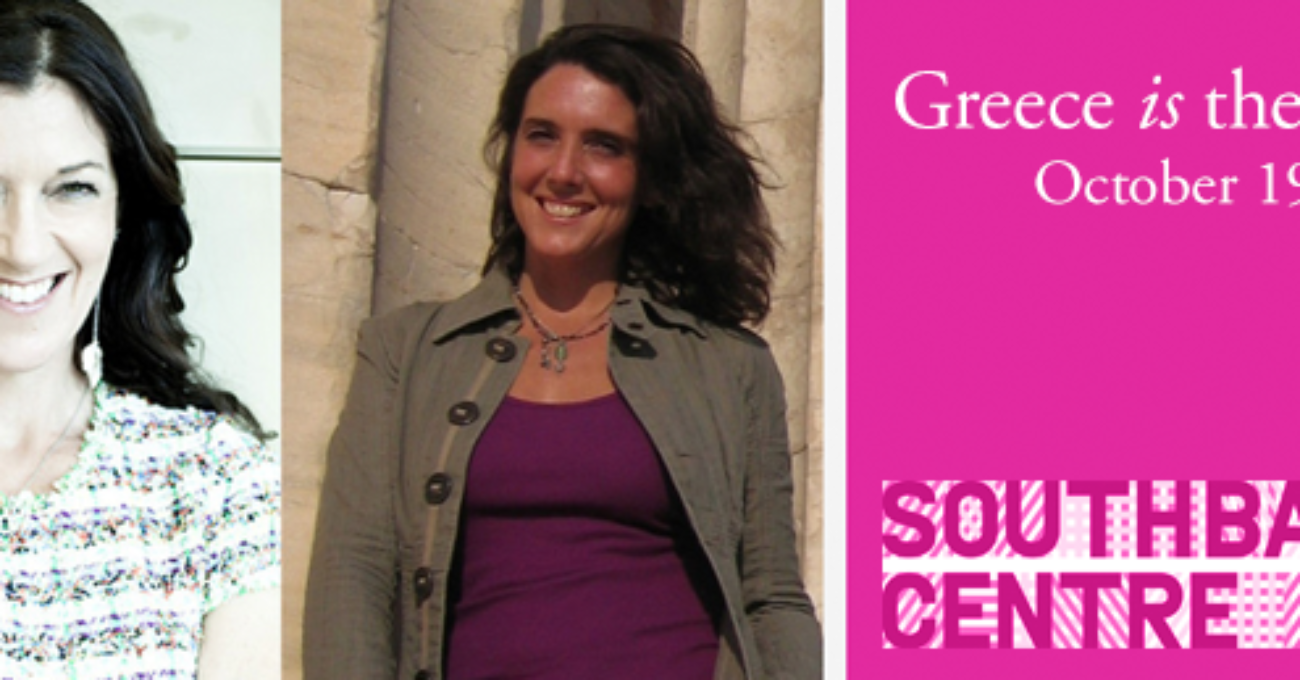
Victoria will be taking part in Greece Is The Word!, a celebration of modern Greek culture and a cutting-edge, creative response to the Greek crisis. Others participating in this one-day event include historian Bettany Hughes, BBC correspondent Paul Mason and a pantheon of Greek stars for a lively day of debate and performance.
Greek Fictions
Victoria, whose ‘Greek novels’ The Island and The Thread have sold millions round the world, talks about modern Greek literature and the challenges facing writers in a country where publishing and bookselling have collapsed. She’s joined by top Greek novelists Ioanna Karystiani (Back to Delphi), Alexis Stamatis (Bar Flaubert), Dionysis Kapsalis, Vassilis Amanatidis and David Connolly for readings and chat.
Enjoy poetry from inspirational performer Katerina Iliopoulou, comedy from brilliant stand-up Katerina Vrana, top analysis from journalist Maria Margaronis and lyrical literature from Ioanna Karystiani and Alexis Stamatis.
Greece is the word is supported by the European Commission and by Arts Council England.
We use cookies on our website to give you the most relevant experience by remembering your preferences and repeat visits. By clicking “Accept All”, you consent to the use of ALL the cookies. However, you may visit "Cookie Settings" to provide a controlled consent.
This website uses cookies to improve your experience while you navigate through the website. Out of these, the cookies that are categorized as necessary are stored on your browser as they are essential for the working of basic functionalities of the website. We also use third-party cookies that help us analyze and understand how you use this website. These cookies will be stored in your browser only with your consent. You also have the option to opt-out of these cookies. But opting out of some of these cookies may affect your browsing experience.
Strictly necessary cookies are absolutely essential for the website to function properly. These cookies ensure basic functionalities and security features of the website, anonymously.
Cookie
Duration
Description
__cf_bm
30 minutes
This cookie is set by CloudFlare. The cookie is used to support Cloudflare Bot Management.
__cfduid
1 month
The cookie is used by cdn services like CloudFlare to identify individual clients behind a shared IP address and apply security settings on a per-client basis. It does not correspond to any user ID in the web application and does not store any personally identifiable information.
_icl_visitor_lang_js
1 day
This cookie is stored by WPML WordPress plugin. The purpose of the cookie is to store the redirected language.
bp-activity-oldestpage
session
This cookie is set by the provider Buddy Press activity. This cookie is used for storing the information when navigating through the pages. It helps to provide a "load more button".
cookielawinfo-checkbox-analytics
11 months
This cookie is set by GDPR Cookie Consent plugin. The cookie is used to store the user consent for the cookies in the category "Analytics".
cookielawinfo-checkbox-functional
11 months
The cookie is set by GDPR cookie consent to record the user consent for the cookies in the category "Functional".
cookielawinfo-checkbox-necessary
11 months
This cookie is set by GDPR Cookie Consent plugin. The cookies is used to store the user consent for the cookies in the category "Necessary".
cookielawinfo-checkbox-others
11 months
This cookie is set by GDPR Cookie Consent plugin. The cookie is used to store the user consent for the cookies in the category "Other.
cookielawinfo-checkbox-performance
11 months
This cookie is set by GDPR Cookie Consent plugin. The cookie is used to store the user consent for the cookies in the category "Performance".
lang
This cookie is used to store the language preferences of a user to serve up content in that stored language the next time user visit the website.
PHPSESSID
session
This cookie is native to PHP applications. The cookie is used to store and identify a users' unique session ID for the purpose of managing user session on the website. The cookie is a session cookies and is deleted when all the browser windows are closed.
viewed_cookie_policy
11 months
The cookie is set by the GDPR Cookie Consent plugin and is used to store whether or not user has consented to the use of cookies. It does not store any personal data.
wpml_browser_redirect_test
session
This cookie is set by WPML WordPress plugin and is used to test if cookies are enabled on the browser.
Analytics cookies are used to understand how visitors interact with the website. These cookies help provide information on metrics the number of visitors, bounce rate, traffic source, etc.
Cookie
Duration
Description
__qca
12 months
This is an analytics cookie set by Quantcast Measure. You can opt-out of all measurement by Quantcast via their site.
_ga
2 years
This cookie is installed by Google Analytics. The cookie is used to calculate visitor, session, campaign data and keep track of site usage for the site's analytics report. The cookies store information anonymously and assign a randomly generated number to identify unique visitors.
_gat
1 minute
This cookies is installed by Google Universal Analytics to throttle the request rate to limit the colllection of data on high traffic sites.
_gid
1 day
This cookie is installed by Google Analytics. The cookie is used to store information of how visitors use a website and helps in creating an analytics report of how the website is doing. The data collected including the number visitors, the source where they have come from, and the pages visted in an anonymous form.
Marketing and advertising cookies are used to provide visitors with relevant ads and marketing campaigns. These cookies track visitors across websites and collect information to provide customized ads.

 A delightful and original new book from multimillion-copy bestselling author Victoria Hislop, author of The Island and The Sunrise
 (from
(from 





 The Culture Behind the Crisis: What You Need to Know
